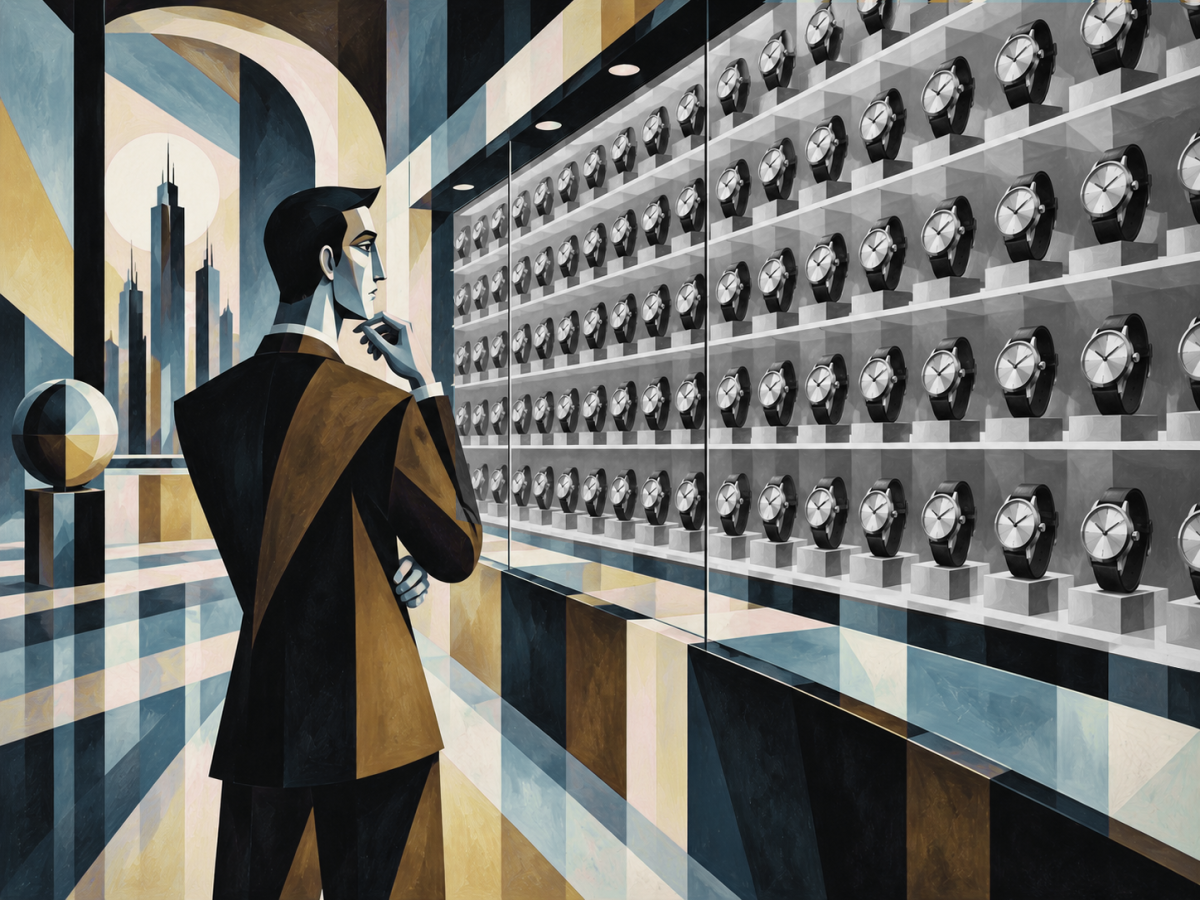
Contemporary watch criticism has developed a remarkably efficient method for judging originality: a new watch appears, someone places it beside an older model, identifies a similar bezel, bracelet, dial, or case shape, and announces that the creative investigation is complete. Design history has apparently been reduced to a matching game, which is convenient if one's ambition is to finish the argument before lunch.
The problem is that design has never developed without precedent. Architecture inherits typologies, automotive design evolves through established proportions and brand codes, fashion continually revisits silhouette and construction, and music would cease to exist if influence itself were evidence of plagiarism. The wristwatch is no different.
It is a mature object with a limited physical vocabulary: case, dial, hands, crown, bezel, lugs, pushers, and bracelet. Certain solutions recur because the human wrist has shown very little interest in radical anatomical innovation, which means originality cannot reasonably be defined as the absence of reference.
Originality instead lies in transformation. The relevant question is not whether familiar elements are present but whether they have been reorganized into a new identity, whether the proportion has changed, whether the architecture has evolved, whether the relationship between case and bracelet has been reconsidered, and whether the graphic language has been transformed enough to establish authorship.
This is the distinction between imitation and reinterpretation. Imitation borrows an existing solution because the meaning is already attached to it, while reinterpretation understands the original logic and changes it, which is often a subtle process and therefore requires more than visual pattern recognition.
The reverse error is equally common, because a watch can look unlike anything familiar and still be conceptually empty. Strange materials, extreme skeletonization, theatrical displays, or aggressive geometry may produce immediate difference without producing a coherent idea, and novelty becomes very easy when coherence is optional.
The strongest designs acknowledge history without being trapped by it. They absorb references so thoroughly that the resulting object becomes unmistakably its own, which is a far more sophisticated achievement than simply inventing a shape nobody has seen before.
Horology should be particularly comfortable with this idea because the entire field is built on continuity, yet it continues to celebrate traditional complications, historical movement architecture, inherited finishing methods, and archival design codes while occasionally becoming outraged when contemporary designers remember that the past exists.
The critic's task is therefore not to identify ancestry but to determine whether the design has moved beyond it, because great objects do not need to be without ancestors; they need to become worthy ancestors themselves.
Becoming a movement analyst is easy while becoming an art critic requires a lot of education; that may be the reason.