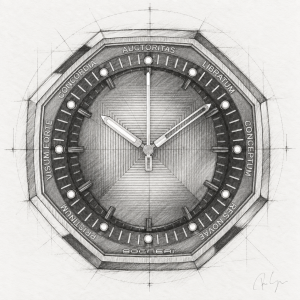
B03 Parallax - A Curator's Take

Below, a very unusual approach in the world of horology, yet at the core of the foundation of the design of the B03-Parallax.


At times, an art curator language seems more proper to define and expose the nature of the B03, the message and the overall phylosophical strucure that ultimately defined all the shapes.


For the ones out there who are also tired of a world predominately dominated by millimeters, lignes, number of jewels, frequency, Hertz, V/h, B/h ; a different way to define a watch may be somehow quite refreshing. 


Preface

From painting and sculpture to performance, motion, and digital art, artistic practice has continually evolved through the search for new forms of expression.

Each new medium expands the possibilities of how ideas can be communicated, experienced, and felt.

This work emerges from that same impulse: to explore a different language for thought, perception, and reaction.


Discovery

Investigate artistic expression

within a new medium for communication.


Medium

The Wristwatch,

 a medium bound by multiple elements and properties:

Size, ergonomics, materiality, technology, engineering, scale.


Objective

Artistic expression by delivering meaning, provoking thoughts, create emotions and ultimately inspire.


Message

Be inquisitive, including the deepest meaning of life.

Live time as moments and not the sum of it.


Delivery Method

Create a visual juxtaposition between expectation and reality.

Expectation actively biases perception.

Expectation is satisfied by providing elements that fulfils it.

The same elements, when looked at a different angle reveal reality. Perception has failed.

Quest begins.


Tools

Circle, Square, Octagon – Foundation and groundwork for the creation

Opposites and its unifying shape

Flat – Expectation       vs.       Depth – Reality

What is expected to be flat turns out to have depth.

Shapes that are expected to be true geometry forms, are not.

Everything changes with perspective.


Disturbing Noise:

As reality is often disguised, the creation integrates “noise”

to confuse the observer.

Light, shadows, and reflections act as a natural interference,

yet can be revealing rather than deceptive

with attentive examination.



What Parallax does


Perception and Reality
The Parallax  creates a dialogue between perception and reality.

Just as the octagon unites the circle and the square, the watch brings together the known and the unknown, certainty and discovery.

It begins with the idea that what we see is not always the full reality.


Perspective Changes What We See
That idea comes to life as the Parallax changes its appearance from different angles. The watch reminds us that, just as its form changes with perspective, so can the way we see and understand life.

A different point of view can reveal something that was there all along.


A Catalyst for Reflection
This shift in perspective is what makes Parallax a catalyst for reflection. It inspires creativity, curiosity, courage, and imagination, inviting us to question what seems obvious, explore new possibilities, and pursue what may seem impossible. What looks like fantasy today may simply be a reality we have not yet learned to see.


How


At first glance, Parallax appears to be exactly what the mind expects a watch to be: a flat dial, familiar hands, recognizable hour markers, an ordinary composition understood almost instantly. Expectation completes the image before the eye has truly examined it. Yet one small clue—a reflection, a distortion of light—suggests that something is not quite as it seems. It is a detail that may escape the casual observer, but to the attentive eye it becomes an invitation to look again.


As the wrist turns, certainty begins to dissolve. What appeared flat reveals depth; the dial rises into a complex surface, the hands curve, the markers assume different heights, and familiar geometries transform. Nothing has changed except the observer’s perspective. The watch was never what it first appeared to be. Expectation created one reality; investigation revealed another. Parallax turns this simple act of changing perspective into a reminder that what we accept as truth is often only the most immediate interpretation of it.


Time itself is treated in the same way. We speak of hours, days, and years as though time were a continuous and measurable whole, yet life is only ever experienced one moment at a time. On Parallax, each hour and second marker differs from the one before and the one after, giving every instant its own presence. No moment can be repeated, and none should be taken for granted. In a universe without guarantees, the watch becomes less a measure of accumulated time than an invitation to inhabit it—to recognize that every second is singular, every day finite, and every moment worthy of attention.


Finally, the rotation of the wrist echoes the movement of a sunset. As the dial turns away, its sculpted surface gradually disappears, like the sun descending beyond the horizon. Sunset has always placed humanity at the threshold between the visible and the unknown: a daily encounter with a universe far greater than what we have discovered or understood. In that fleeting transition, Parallax leaves us with its central idea: reality is larger than perception, truth can change with perspective, and discovery begins the moment we decide to look again.


Core Definitions


  • Expectation: A forward-looking mental belief or prediction about what will happen, built from past experiences and memory.
  • Perception: The present-moment process of taking in and interpreting sensory signals from your environment.


How Expectation Influences Perception


  • Faster processing: Expected objects or events enter our conscious awareness much faster than unexpected ones.
  • Perceptual confirmation: People often perceive what they expect to see, even if reality differs.
  • Top-down processing: The brain uses prior beliefs to make sense of weak or confusing signals, helping experts spot details novices miss.
  • Confirmation bias: Attention tunes toward details that match your beliefs while ignoring conflicting facts


How Perception Updates Expectation


  • Feedback loop: When reality clashes sharply with a prediction, it creates a "prediction error".
  • Learning: These errors update your memory, changing what you expect to happen next time.