B03 Parallax - Historical Context

I. The last unexamined surface
Every medium is a set of refusals.

The wristwatch refuses more than most: it must be small, it must survive the body, it must be legible in the time it takes to lift an arm, and it must then get out of the way.

For a century it has been the perfect object of design precisely because it asks nothing of the person wearing it. Art has rarely bothered with it, and for good reason. There is nowhere to put the doubt.

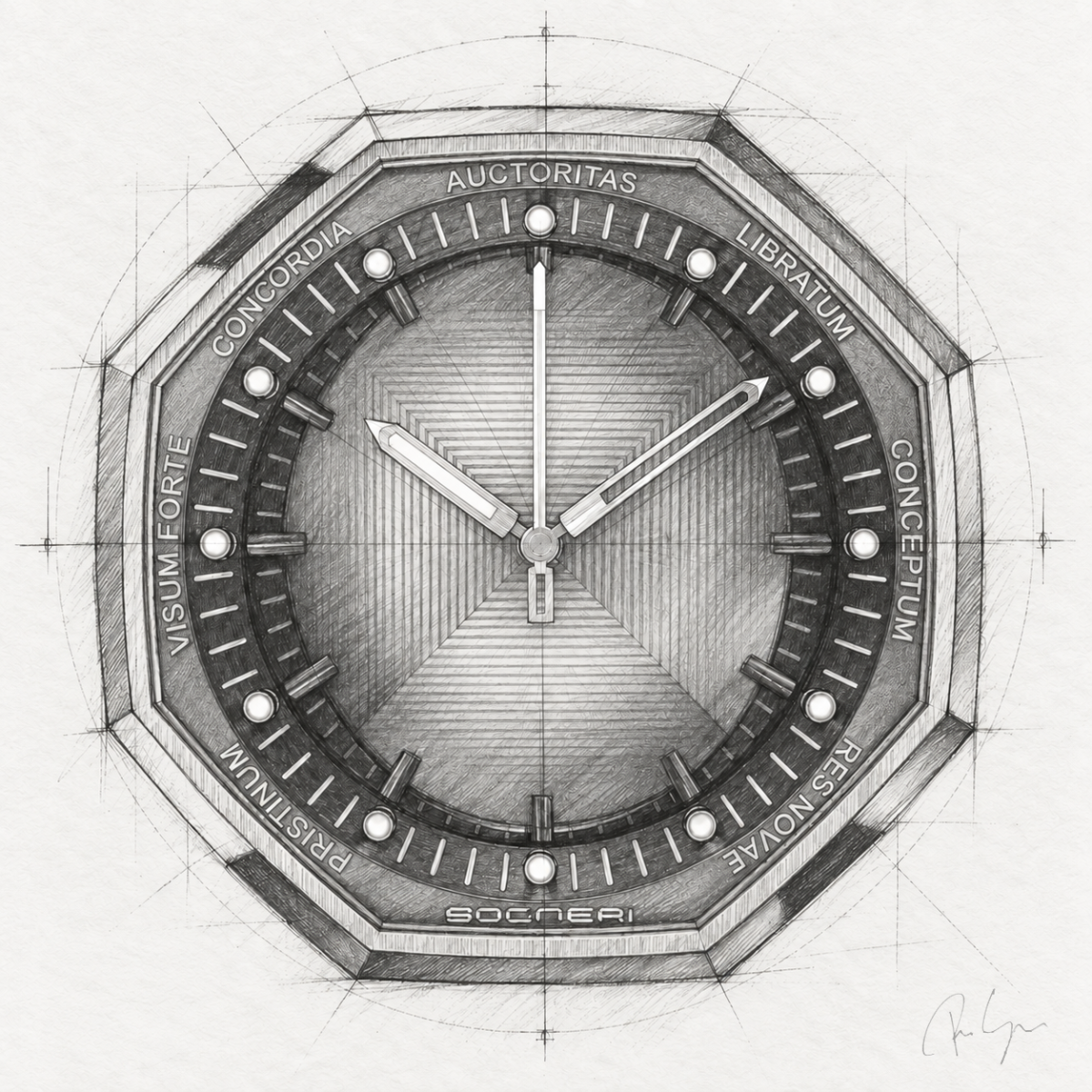
Parallax begins from the opposite premise. It treats the constraints of the wrist, scale, materiality, ergonomics, engineering, not as the limits of a product but as the boundaries of a medium, in the way that Fontana's cut treated the canvas as an object with a space behind it.

The dial is not a display. It is a relief.

The thing worn on the wrist is a sculpture that happens to tell the time, and the telling is only its alibi.

Parallax’s own formulation is blunter: craft creates objects, meaning creates art.
 

Holbein's The Ambassadors (1533)

Holbein's The Ambassadors (1533)

Castellani's Superfici (from 1959)

Castellani's Superfici (from 1959)

II. A lineage of oblique surfaces
The idea has ancestors, and they are worth naming, because Parallax is more legible inside them than alone.

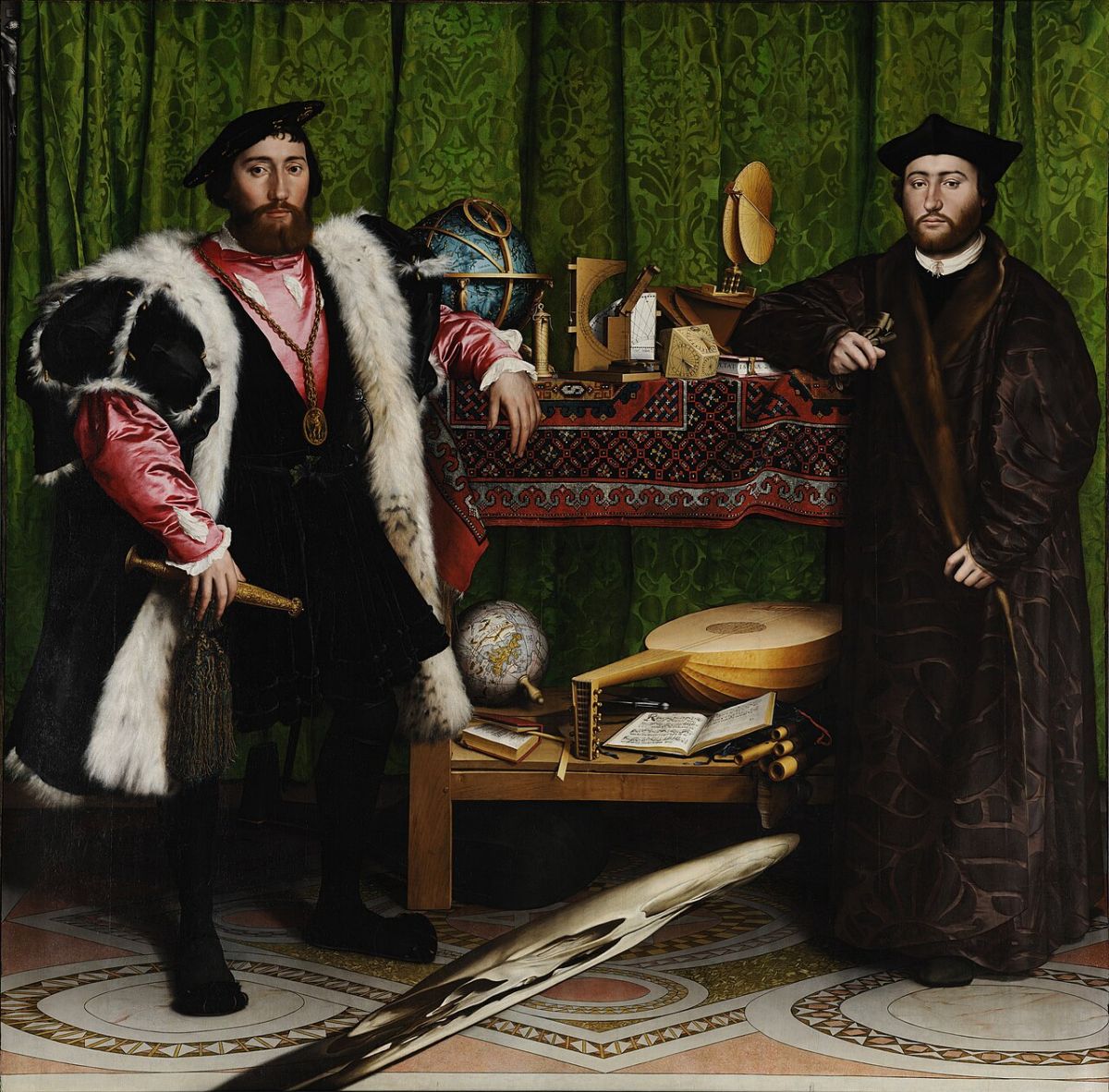
The oldest is anamorphosis. In Holbein's The Ambassadors (1533), a grey smear cuts across the floor between two men surrounded by the instruments of measurement, globes, a quadrant, a sundial. Seen from the front it is a flaw. Seen from the right-hand edge, at a steep angle, it resolves into a skull. The painting withholds its meaning from anyone who stands where paintings expect us to stand, and gives it to whoever moves. It is also, not incidentally, a memento mori hidden inside a portrait of worldly certainty.

The nearest ancestors are Italian and postwar.

Enrico Castellani's Superfici (from 1959) are monochrome canvases pushed into relief by nails from behind, so that the work is not the surface but the light raking across it, and changes as the viewer walks.

Agostino Bonalumi's extroflexions and Getulio Alviani's superfici a testura vibratile, milled aluminium that shimmers and reverses as one passes, belong to the same family. So does Arte Programmata, the exhibition Bruno Munari organised in Olivetti's Milan showroom in 1962, with a catalogue text by Umberto Eco, whose Opera aperta appeared the same year: the open work, which does not exist until a viewer completes it. Carlos Cruz-Diez's Physichromies (from 1959) made colour a function of the viewer's position, and by 1965 MoMA had gathered the whole tendency under the title The Responsive Eye.

What all of these share is a transfer of authorship. The work does not sit still and wait to be seen. It is produced, each time, by the movement of a body in front of it.

Parallax proposes to take that tradition off the wall and put it on the body itself, which moves all day whether or not it means to.

 

II. A lineage of oblique surfaces
The idea has ancestors, and they are worth naming, because Parallax is more legible inside them than alone.

The oldest is anamorphosis. In Holbein's The Ambassadors (1533), a grey smear cuts across the floor between two men surrounded by the instruments of measurement, globes, a quadrant, a sundial. Seen from the front it is a flaw. Seen from the right-hand edge, at a steep angle, it resolves into a skull. The painting withholds its meaning from anyone who stands where paintings expect us to stand, and gives it to whoever moves. It is also, not incidentally, a memento mori hidden inside a portrait of worldly certainty.


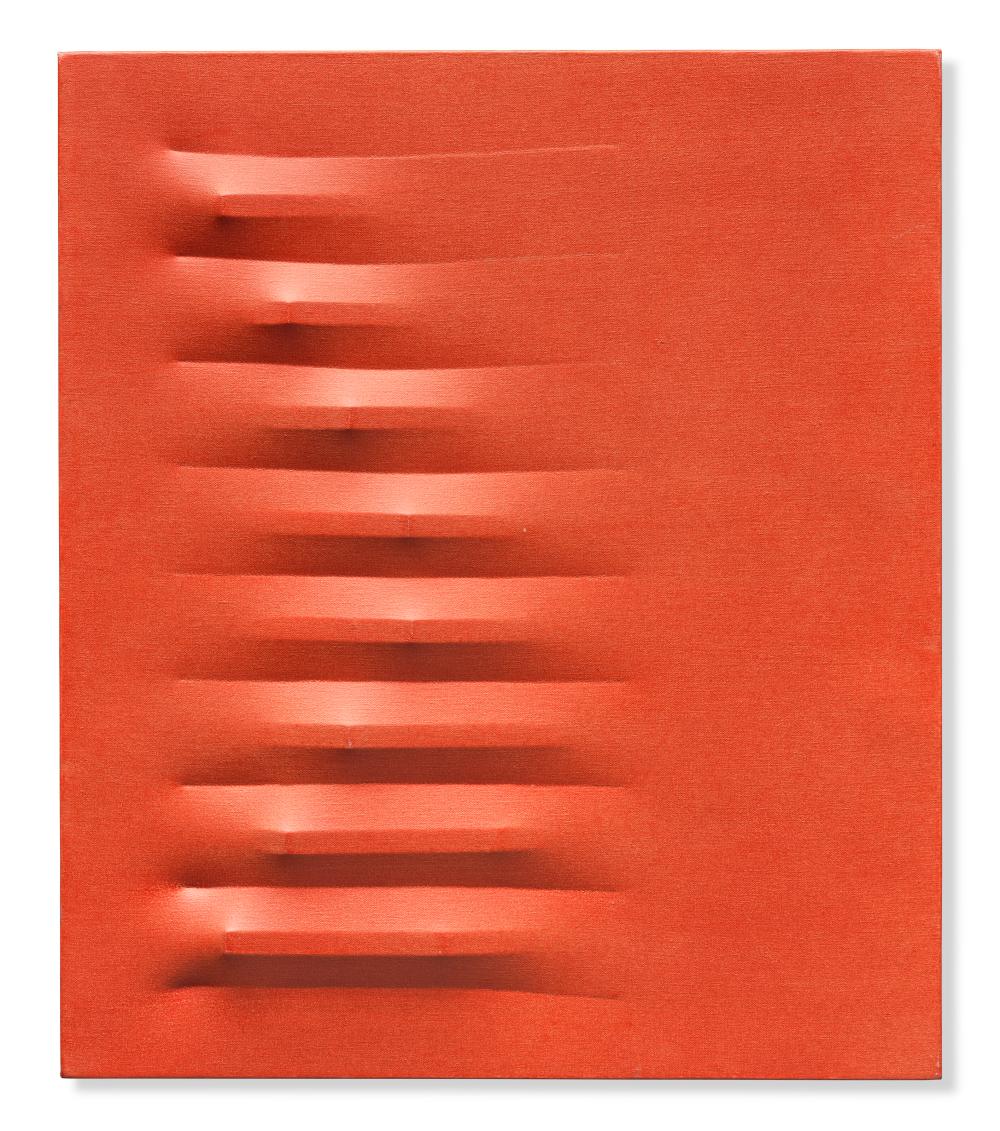
Agostino Bonalumi's extroflexions

Agostino Bonalumi's extroflexions


The nearest ancestors are Italian and postwar.

Enrico Castellani's Superfici (from 1959) are monochrome canvases pushed into relief by nails from behind, so that the work is not the surface but the light raking across it, and changes as the viewer walks.

Agostino Bonalumi's extroflexions and Getulio Alviani's superfici a testura vibratile, milled aluminium that shimmers and reverses as one passes, belong to the same family. So does Arte Programmata, the exhibition Bruno Munari organised in Olivetti's Milan showroom in 1962, with a catalogue text by Umberto Eco, whose Opera aperta appeared the same year: the open work, which does not exist until a viewer completes it. Carlos Cruz-Diez's Physichromies (from 1959) made colour a function of the viewer's position, and by 1965 MoMA had gathered the whole tendency under the title The Responsive Eye.

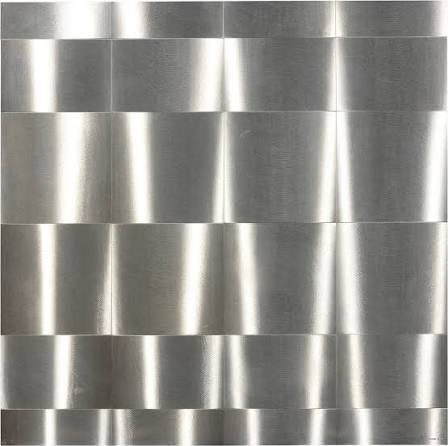
Getulio Alviani's superfici a testura vibratile

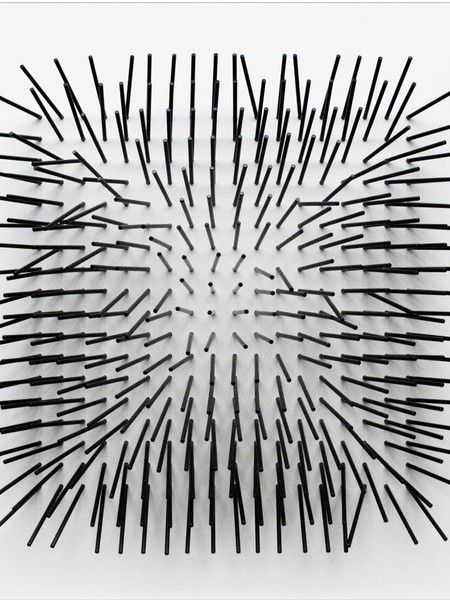
Arte Programmata – Bruno Munari

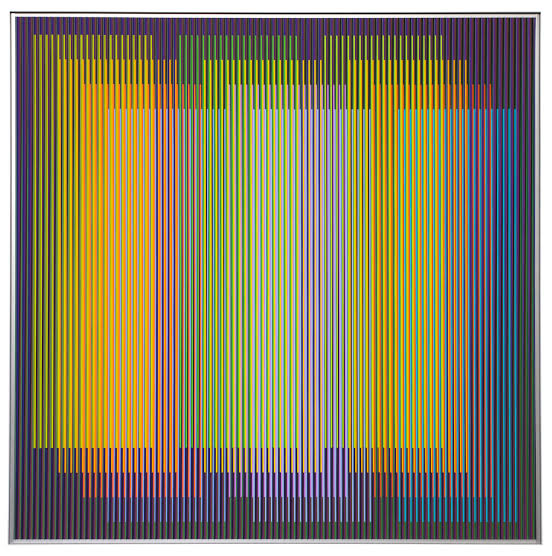
Carlos Cruz-Diez's Physichromies (from 1959)

Agostino Bonalumi's extroflexions


The nearest ancestors are Italian and postwar.

Enrico Castellani's Superfici (from 1959) are monochrome canvases pushed into relief by nails from behind, so that the work is not the surface but the light raking across it, and changes as the viewer walks.

Agostino Bonalumi's extroflexions and Getulio Alviani's superfici a testura vibratile, milled aluminium that shimmers and reverses as one passes, belong to the same family. So does Arte Programmata, the exhibition Bruno Munari organised in Olivetti's Milan showroom in 1962, with a catalogue text by Umberto Eco, whose Opera aperta appeared the same year: the open work, which does not exist until a viewer completes it. Carlos Cruz-Diez's Physichromies (from 1959) made colour a function of the viewer's position, and by 1965 MoMA had gathered the whole tendency under the title The Responsive Eye.

Getulio Alviani's superfici a testura vibratile


What all of these share is a transfer of authorship. The work does not sit still and wait to be seen. It is produced, each time, by the movement of a body in front of it.

Parallax proposes to take that tradition off the wall and put it on the body itself, which moves all day whether or not it means to.

Arte Programmata – Bruno Munari

Arte Programmata – Bruno Munari

Carlos Cruz-Diez's Physichromies (from 1959)

Carlos Cruz-Diez's Physichromies

(from 1959)

IV. Interference as medium
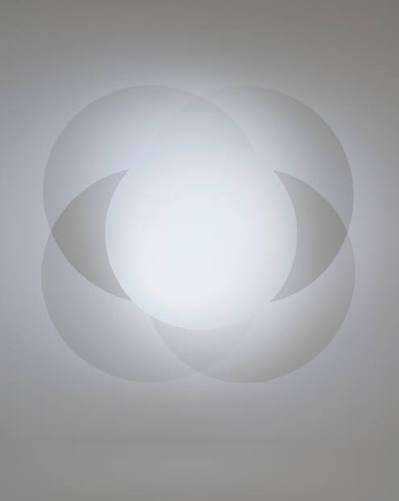
Watchmaking has spent enormous effort eliminating reflection. Anti-reflective coatings, matte dials, the whole apparatus exists to remove anything that comes between the eye and the time. Parallax reverses the polarity. Glass, shadow and tinted reflection are retained as an active layer, a deliberate noise laid over the structure. Robert Irwin's disc paintings of the late 1960s made the shadows the work and let the object dissolve into them; Parallax does something adjacent. The interference is what reveals the depth. To the passing glance it is a veil. To the attentive eye it is the only contrast by which the relief can be read at all. Seeing, in the line of Valéry's that Irwin made his own, is forgetting the name of the thing one sees. The name here is "watch".
 

Robert Irwin's disc paintings of the late 1960s

Robert Irwin's disc paintings of the late 1960s

V. The parallax gap
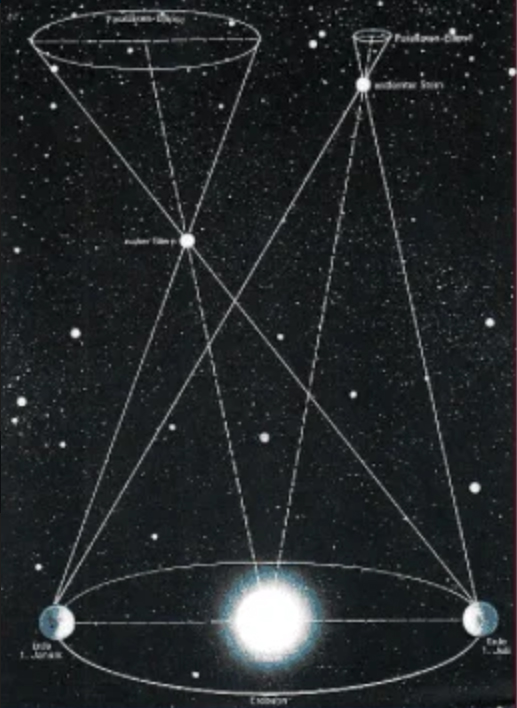
The word deserves its etymology. Parallax is the apparent displacement of an object when the observer moves, and it is how distance was first measured beyond the solar system: in 1838 Friedrich Bessel watched the star 61 Cygni shift against its background as the Earth moved from one side of its orbit to the other, and from that shift computed how far away it was. Depth, in other words, is not seen. It is inferred from the difference between two positions. A single viewpoint is always flat.

Slavoj Žižek, borrowing from Kojin Karatani, later made the term philosophical: “the parallax gap”, two perspectives on the same thing that cannot be reconciled into one, where the gap is the truth rather than an obstacle to it. One need not follow him all the way to notice that Parallax puts a small, wearable version of that gap on the wrist. The flat watch and the sculpted one are both real. Neither is a lie. What the object insists on is that you cannot have them from the same place.
 

Friedrich Bessel Observation

Friedrich Bessel Observation

VI. Singular time
A seventeenth-century vanitas would set a pocket watch among the skull and the guttering candle, a reminder that the instrument of measurement is also the instrument of mortality. Parallax keeps the reminder and drops the moralising. No two hour or second markers on the dial are alike. Each instant is given its own presence. Time is presented not as an accumulation of identical units but as a sequence of moments that will not recur, which is, after all, the only form in which anyone has ever experienced it.

And as the wrist turns away, the relief slowly sinks beneath the curve of the case, the way the sun drops behind a horizon. Sunset has always placed us at the threshold between the visible and the unknown, a daily encounter with a universe far larger than what we have understood. Parallax leaves its wearer there, several times an hour.

It is not an instrument for measuring accumulated time. It is an argument, made in metal and glass, that reality is larger than perception, that truth changes with the position of the body, and that discovery begins the moment we decide to look again.

Parallax