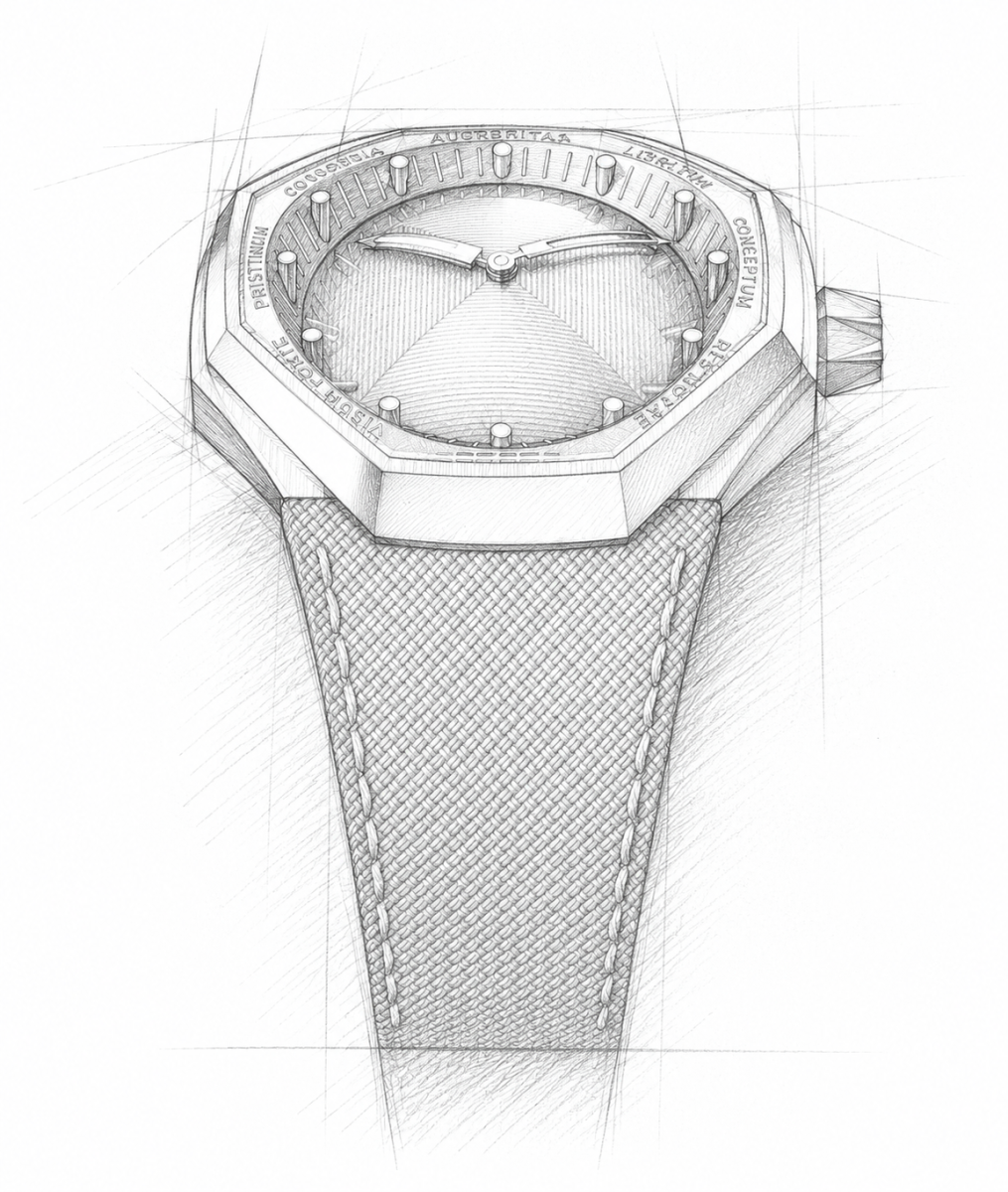
The dial of the B-03 Collection itself is domed. This single decision sets off a cascade of technical challenges throughout the manufacturing process. Unlike a flat surface, a domed dial requires exceptional precision and accuracy at every stage to achieve the final result.
Each step that is taken to celebrate traditional craft and heritage in watchmaking require additional layers of pre-planning, engineering and careful execution to accomplish the highest standards that are historically accomplished on flat surfaces.
The Bogneri B-03 dial embodies different finishing techniques within the same object: Guilloché, Sunburst, enameling with fumé, all integrated within a curved surface.
The guilloché pattern is three-dimensional. While the motif itself is deliberately restrained, applying it to a domed surface introduces extraordinary complexity. The engraving tool must remain perpendicular to the tangent plane at every point of contact, meaning that the engraving process continuously shifts vertically through three-dimensional space while simultaneously changing its angle relative to the machine’s normal axis.
The motif is intentionally the square, a shape that typically strongly juxtaposes with the surrounding circle, and at the same time the circle that is part of the dome itself. The dialogue between the square, symbolizing the earthly material realm, and the circle, representing the heavens and the divine is clear. The square is a perfect square when seen from the top, typical angle for wristwatch immortalization, but when the timepiece is rotated it becomes a rhomboid where the corners are no longer square angles but start to deform as we change to view angle, to symbolize our need to explore what we perceive as obvious to stimulate our imagination, creativity and braveness within a journey that can be both material and spiritual.
The sunray finish is applied to a domed surface — a radical departure from traditional, flat-surface applications, it is therefore crafted on the small surfaces that appear as flat due to their scale but are indeed curved upon a magnified observation. The message is again that careful analysis can lead to results completely different from what is initially established.
The enameling is also non-flat. As a result, hand-finishing becomes exponentially more difficult, as the process cannot rely on a rotating flat plane to allow exceptional control.
The procedure becomes something where hand crafting reaches its limit and machines must intervene to find the precision within the smallest tolerances needed. The undeniable truth is exposed within this procedure, and it is that machines are not replacing craft, but are merely superior tools created by mankind to bring the level of craft to a higher level of expression. In parallel even a stick of wood used for a perfect anglage is a tool.