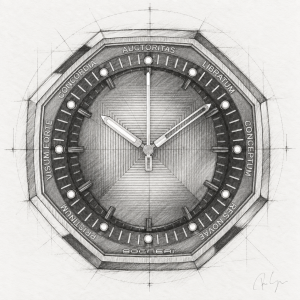
Watch collecting is personal, but criticism should not be, and the failure to separate the two has produced some of the least interesting arguments in the culture. A negative observation about a watch can provoke the kind of emotional defense usually reserved for politics or family, as though identifying an awkward case profile had somehow insulted the owner's ancestry.
People are free to love imperfect objects, and they should, because collecting would be unbearable if every purchase required approval from an imaginary committee of design professors. A watch can be charming and badly proportioned, derivative and emotionally irresistible, beautifully made and visually confused, while a brilliantly resolved design may leave another collector completely indifferent.
None of this becomes problematic until personal attraction is presented as evidence of quality. “I like it” is a perfectly complete statement of preference, but it is a very poor critical argument because serious evaluation asks whether the composition holds together, whether the proportions are convincing, whether the visual hierarchy is clear, whether the details reinforce the whole, and whether the object communicates intention rather than simply collecting features.
Other creative disciplines understood this distinction long ago. An architecture critic does not need to want to live in a building, and a curator does not need to hang a painting above the sofa, because the ability to separate desire from evaluation is precisely what allows criticism to become useful.
Horology often resists this because watches are intimate objects. They are worn, inherited, photographed, discussed, and used as expressions of identity, which makes criticism feel more personal than it should. A design does not become stronger because it is loved, however, nor does a critic become correct because he sounds confident, which means the argument still has to be made.
This is where expertise earns its place, not because experts should determine what everyone is allowed to enjoy, but because informed observation produces better explanations. A trained eye can identify, through an educated and objective commentary, why a dial feels congested, why a bezel overwhelms the case, or why a bracelet transition appears unresolved, and those observations can then be challenged on their merits rather than dismissed as preference.
The purpose of criticism is not to eliminate disagreement but to make disagreement intelligent. Collectors should be able to love a flawed watch without pretending the flaws do not exist, because affection becomes more interesting when it is no longer forced to double as self-validation.