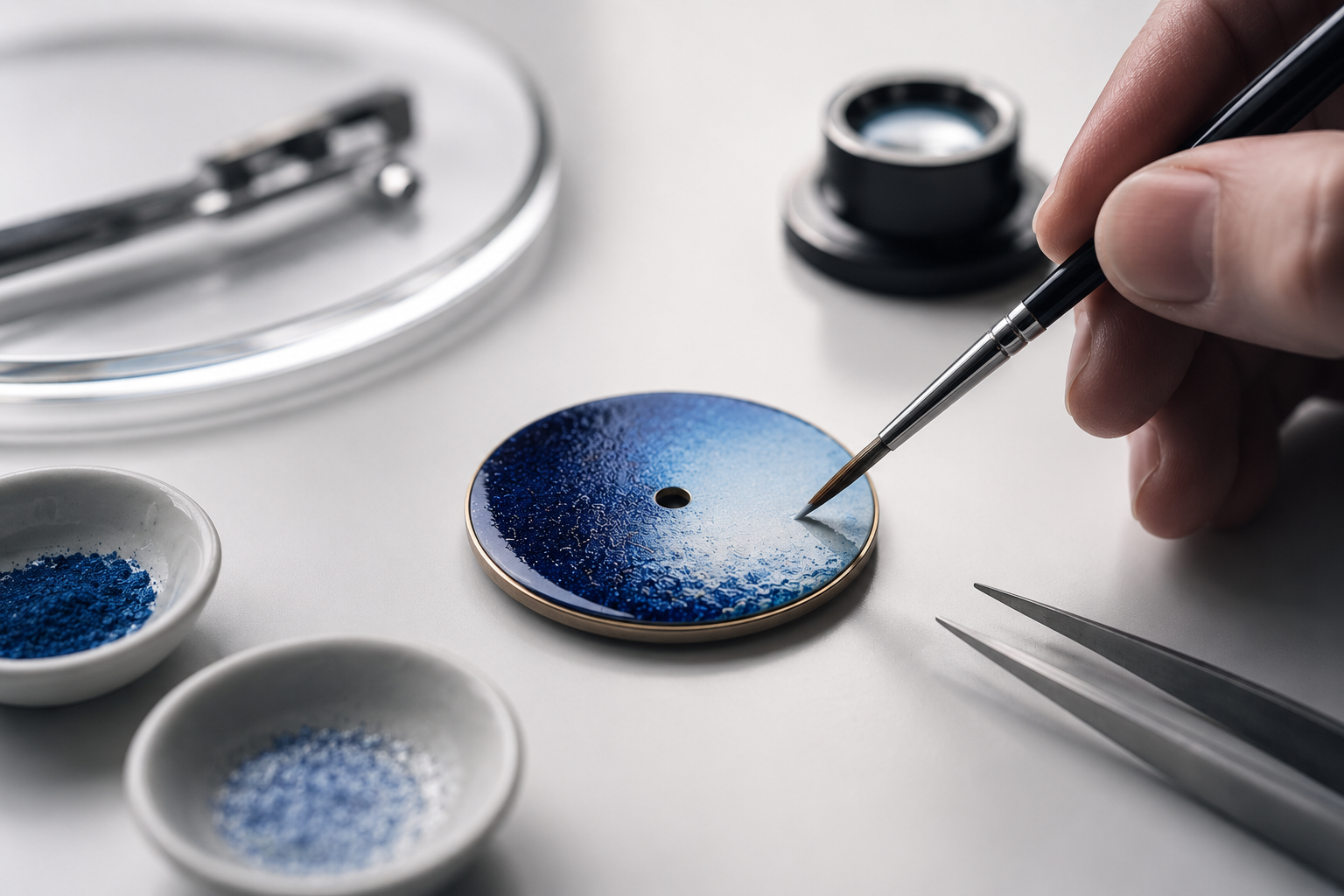
In an age where technology can reproduce almost anything with astonishing precision, there remains a rare craft that continues to defy automation. It is a discipline where fire becomes an artist's brush, where patience outweighs speed, and where the slightest imperfection can mean starting over from the beginning. This is the world of enameling—a centuries-old decorative art that has become one of the most revered expressions of craftsmanship in fine watchmaking.
For collectors and enthusiasts, an enamel dial possesses a captivating quality that is difficult to describe yet impossible to ignore. Its depth, brilliance, and permanence create a visual experience unlike any painted or printed surface. Beneath its flawless appearance lies an extraordinary journey of skill, risk, and artistry.
A Heritage Measured in Centuries
Enameling predates watchmaking itself. The technique has been used for thousands of years to decorate jewelry, ceremonial objects, and works of art. By the 17th century, master craftsmen began applying enamel to pocket watches, transforming timekeeping instruments into miniature masterpieces.
Today, despite the advancement of modern manufacturing methods, enamel remains one of the most prestigious decorative techniques in haute horlogerie. Only a handful of artisans around the world possess the expertise required to create truly exceptional enamel dials, making each piece not merely a component of a watch but a work of art in its own right.
What Exactly Is Enamel?
At its essence, enamel is finely ground glass.
The material is created by fusing silica, minerals, and metallic oxides at extremely high temperatures. Once cooled, the resulting glass is crushed into a fine powder. Different minerals and oxides are added to achieve specific colors, from brilliant whites and deep blues to vibrant reds and rich greens.
When this powder is applied to a metal surface and heated in a kiln, it melts and fuses into a smooth, glass-like layer. Through multiple firings, the enamel develops remarkable depth, luminosity, and durability.
Unlike paint, enamel does not fade over time. It retains its brilliance for generations, often looking as vibrant centuries later as it did on the day it was created.
The Delicate Process
Creating an enamel dial is a labor-intensive process that can take days or even weeks to complete.
The journey begins with a metal base, typically crafted from gold, copper, or another suitable alloy. The surface must be meticulously prepared to ensure the enamel will adhere properly during firing.
The enamel powder is then mixed with water or oil to create a workable paste. Using tiny brushes, spatulas, or specialized tools, the artisan carefully applies the material to the dial.
At this stage, the dial may appear far from beautiful. The magic has yet to happen.
The dial is placed inside a kiln heated to temperatures that can exceed 800 degrees Celsius. As the enamel melts, it transforms into a glossy, translucent surface. Once fired, the dial is removed and allowed to cool before being inspected.
This process is repeated again and again.
Additional layers are applied and fired individually to achieve the desired color, depth, and uniformity. Some dials require ten, fifteen, or even twenty separate firings before they reach completion.
Each firing introduces risk. A dial that appears flawless after several successful stages can crack, warp, discolor, or develop microscopic imperfections during the final firing. If this happens, the artisan often has no choice but to begin anew.
The Different Styles of Enamel
Within watchmaking, enameling encompasses several distinct techniques, each demanding unique skills.
Grand Feu Enamel
Often considered the purest and most prestigious form, Grand Feu—meaning "great fire" in French—involves repeatedly firing enamel at high temperatures to achieve exceptional depth and brilliance.
The resulting surface possesses an unmatched luster and permanence. However, it is also among the most difficult techniques to master due to the high probability of failure during firing.
Cloisonné Enamel
This technique uses delicate gold wires to create miniature compartments, or cloisons, on the dial surface.
Each compartment is filled with colored enamel and fired individually. The result resembles a stained-glass mosaic, often depicting landscapes, animals, or intricate scenes with extraordinary detail.
A single cloisonné dial can require hundreds of hours of labor.
Champlevé Enamel
Rather than building compartments with wires, champlevé involves carving recesses directly into the metal surface. These cavities are then filled with enamel and fired.
The process creates rich visual contrasts between polished metal and luminous enamel colors.
Miniature Painting
Among the most artistic forms of enameling, miniature painting transforms a watch dial into a canvas.
Artists apply microscopic layers of enamel pigments to create portraits, historical scenes, or highly detailed illustrations. Multiple firings are required throughout the painting process, with every layer permanently fused by fire.
The precision demanded is astonishing, particularly when the entire artwork may occupy a space smaller than a coin.
Why Is Enameling So Challenging?
The greatest challenge of enameling lies in its unpredictability.
Unlike modern industrial processes, enameling remains partially governed by the behavior of fire itself. Temperature variations, cooling rates, material composition, and even humidity can influence the final result.
An artisan may invest dozens of hours into a dial only to see it ruined in the kiln within seconds.
The margin for error is virtually nonexistent. Dust particles, microscopic cracks, uneven application, or slight shifts in color can render a dial unacceptable.
This inherent risk explains why enamel dials are so rare and highly valued. Their creation demands not only technical mastery but also extraordinary patience and resilience.
Many enamel artisans spend decades refining their craft before achieving true mastery.
The Beauty That Cannot Be Replicated
What makes enamel so captivating is the quality of light it creates.
Unlike lacquer, paint, or printed surfaces, enamel possesses remarkable depth. Light penetrates the translucent layers before reflecting back through the material, creating a subtle glow that seems to originate from within.
This luminous quality changes throughout the day, revealing different nuances depending on the angle and intensity of light.
Equally remarkable is enamel's permanence.
Because the colors are fused into glass rather than applied to the surface, they resist fading, oxidation, and discoloration. An enamel dial created today may look nearly identical a century from now.
Collectors often describe enamel dials as possessing a soul—a living quality that evolves with every glance yet remains timeless.
A Testament to Human Craftsmanship
In today's world of efficiency and mass production, enameling stands as a powerful reminder of what human hands can achieve.
Every enamel dial tells two stories. One is visible: the breathtaking beauty of the finished piece. The other remains hidden within the layers of glass and color—the countless hours of preparation, the repeated journeys through fire, the failures, the risks, and the unwavering dedication of the artisan.
When viewed through this lens, an enamel dial becomes more than a decorative element. It becomes a testament to patience, mastery, and the pursuit of perfection.
Perhaps that is the true magic of enameling.
It transforms something as practical as a watch into something deeply emotional. It captures fire, time, and artistry within a few square centimeters of extraordinary beauty—creating a miniature masterpiece destined to outlive generations.
And in a world increasingly defined by the temporary, that permanence feels nothing short of miraculous.