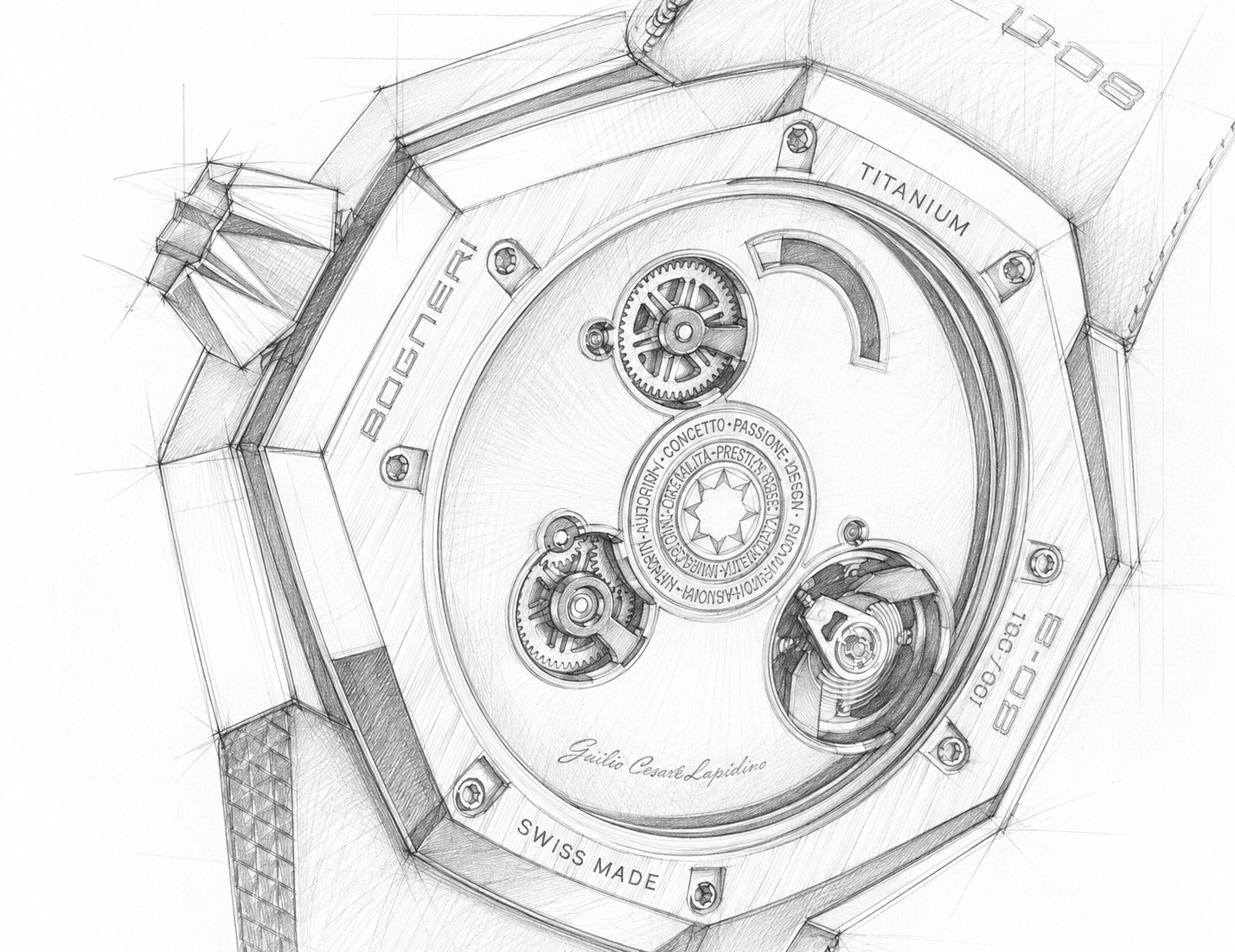
The design of the Bogneri caseback is founded on a simple philosophical principle: not everything worthy of admiration must be entirely exposed. True significance often emerges through restraint rather than abundance.
Throughout the history of philosophy, thinkers have recognized that concealment is not the opposite of truth but one of its conditions.
Plato suggested that the visible world often distracts us from what is truly real. If appearances can deceive, then concealment may become a way of redirecting attention from the superficial to the essential. In this sense, covering is not an act of denial but of emphasis: by hiding what is commonplace, we invite others to seek a deeper truth.
Aristotle argued that virtue lies in purpose. Every action acquires meaning through its end. Clothing, architecture, ritual, and even language can therefore be understood as intentional acts that distinguish the accidental from the essential. What is covered recedes into the background, allowing what fulfills a higher purpose to emerge with greater clarity.
Friedrich Nietzsche observed that every culture invents masks. Yet the mask is not necessarily falsehood; it can be a creative expression of one's highest self. Concealment becomes an artistic act, while revelation is reserved for what embodies strength, beauty, or excellence. The veil, then, is not merely protection—it is selection.
Martin Heidegger described truth as aletheia, literally "unconcealment." Significantly, unconcealment presupposes concealment. Not everything can appear at once. Meaning arises because some things remain hidden while others are brought into presence. To reveal what counts is therefore an intentional philosophical act, one that grants significance through contrast.
Bogneri embraces this philosophy in its exhibition caseback. Instead of revealing the entire movement, only a carefully selected composition of mechanical elements is framed within openings. Primary functional elements become intentional focal points, while the remaining architecture remains hidden behind a surface that intuitively resembles a front dial, with decorative elements that are conventional to a what we usually see in the front of a watch. This further elevates elements that are usually concealed. Decoration now is not consequential but intentional.
This is not an exercise in omission but in hierarchy. The concealed components continue to perform their indispensable function, yet they do not compete for the observer's attention. By limiting what is visible, every exposed detail acquires greater significance. The eye is invited to contemplate craftsmanship rather than consume complexity.